
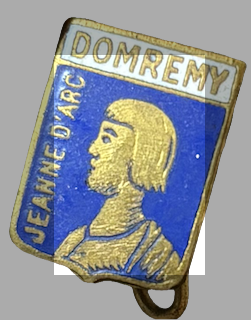
This pin is of Domrémy, the birthplace of Jeanne d’Arc, also known as Joan of Arc in English.
Our family took a day trip to the birthplace and home of Joan of Arc: Domrémy in northeastern France. I remember being impressed by the basket full of baguettes on the bus for our picnic lunch there and of my returning home with a glow-in-the-dark Joan of Arc statue. I talked to the statue at night and put her under my pillow. I loved that statue and developed a love for this Maid d’Orléans from that play.
I was surprised when, years later, two of my students wanted to write a report on her. I had no idea that this maid from a childhood memory was a heroine revered by young women today. She is admired for her bravery and audacity in helping to establish the future King of France, and I took for granted that her visions were important, but didn’t realize that her feats were common knowledge among some young women these days.
While that statue was important to me as a child, I now realize that it was also important to France. While some doubted her, thankfully, two soldiers believed her when she discussed her “visions,” especially when she could describe a battle before it had occurred. They took her to Charles, the disinherited rightful king of France during the Hundred Years’ War with England. Charles was exiled in his own country.
She was dressed as a boy in armor and taken to the future king– she was a teenager, and he was a young man in his twenties. He also believed she was genuine when she shared visions about his inmost thoughts, which he only shared with God, or so I found in my research.
I had no idea that this pin on the Bavarian hat and this childhood memory was so important—both historically and personally.
Joan of Arc led the French soldiers to victory against the odds and eventually escorted Charles to be inaugurated as King Charles VII in 1429 at Reims. This is what her visions told her needed to be done.
I’ve also learned that a new movie will be made soon, adding to the several already made about this inspiring woman who had visions and, just as importantly, was believed. This is the part that intrigues me.
Sadly, after helping Charles become king, she was put through a sham trial and burned at the stake in Rouen in 1431. Charles exonerated her after her death, and she was canonized by Pope Benedict XV in 1920.
I had no idea this iconic young woman, whom I remembered as a glow-in-the-dark statue, had a following.
I checked if there were any glow-in-the-dark statues online; I did not find any, but I did find other kinds of statues available, perhaps more fitting for me now.